
Kitchens and bathrooms work harder than most rooms in a home. Steam rises from the stove. Water splashes around the sink. Damp towels sit next to the vanity. Cabinets in these spaces face moisture every day, and in many homes they face termites too.
Wood and plywood have been the usual choice for years. But more homeowners, designers, and builders now want something that copes better with damp conditions and asks for less upkeep. Wood-plastic composite, known as WPC, is one material that keeps coming up in that search.
This guide explains what a WPC board is, how it can be used in kitchen and bathroom cabinets, how to think about thickness, and how to care for it once it is installed.
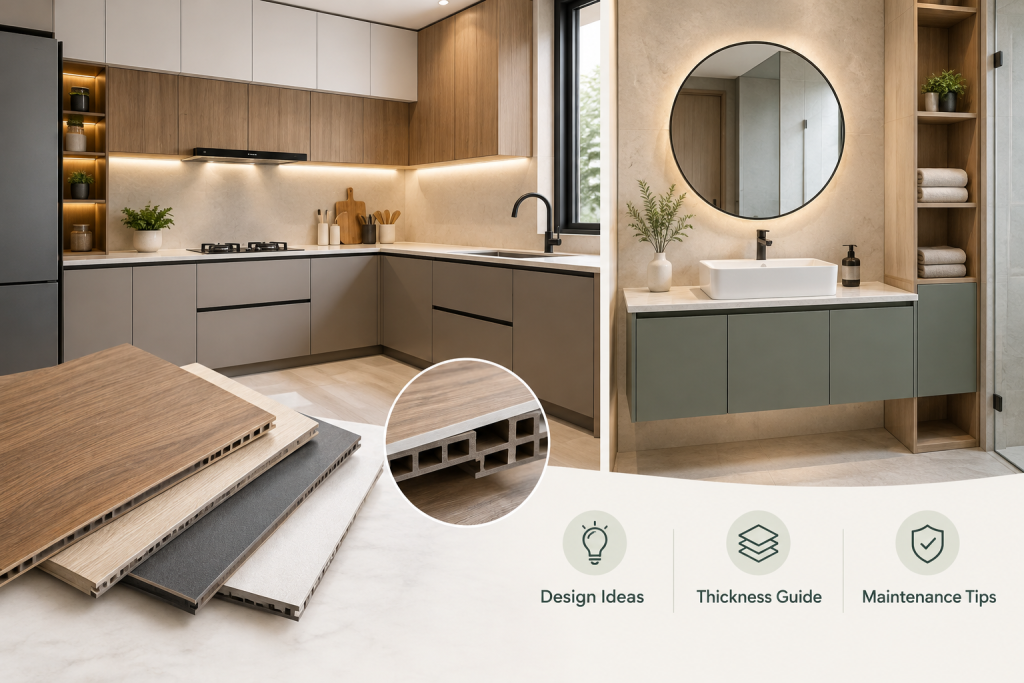
What Is a WPC Board?
A WPC board is made by combining wood fibres with plastic. The finished board looks and feels close to wood, but it behaves differently. It is designed to resist water and to stay free of warping, cracking, and rotting over a long service life.
That matters most in wet rooms. WPC board is used for modular kitchen cabinets, storage units, and other furniture that sits near moisture. It is also used for bathroom vanities and wash cabinets.
These are the features that make it a practical pick for such spaces:
- Water and moisture resistance
- Termite and pest resistance
- No shrinking or swelling
- Bacteria and fungus resistance
- Fire retardant
- Washable and paintable
- 100% recyclable
Design Ideas for Modular Kitchens and Bathroom Cabinets
Design is where WPC board gives you room to work. The board takes paint, supports various finishes, and can be cut and shaped to suit a project. Here are some ways to use those traits.
Kitchen Ideas
- Wood-tone cabinets: Boards can be made in different wood colours to match what a customer wants. You get the warm look of timber without the damage that real wood can suffer in a damp kitchen.
- Painted units: The board is paintable, so cabinet colours can be matched to walls, tiles or counters.
- A clean white base: The standard board is plain white. It is a simple starting point for a bright, modern kitchen.
- One material throughout: Use the same board for base units, wall units and storage cabinets, so the whole kitchen responds to humidity in the same way.
- Laminated surfaces: The board can be glued and laminated, which opens up more finish options.
Bathroom Ideas
- Vanities and wash cabinets: These are core uses for WPC board, since they sit in a spot where moisture is part of daily life.
- Cut-out details: The board suits CNC cutting, so custom decorative shapes are possible.
- Matching wall paneling: Some decorative wall panelling jobs can use the same material as the cabinet, which keeps the room consistent.
- Coordinated storage: Wardrobes, cupboards and other cabinets in the rest of the house can use the same board for a matching look.
Carpenters and fabricators tend to find the material easy to work with. It is easy to mould and screw; it can be sawed and cut to size, and it supports quicker installation. The surface is also smoother than plywood, which helps when you plan a paint or laminate finish.
WPC Board Thickness Guide
Thickness is one of the first things buyers ask about. Here are the standard specifications for WPC board from JKD Plastics:
- Thickness range: 3 mm to 30 mm
- Standard width: 1220 mm (48 inches)
- Standard length: 2000 mm to 6100 mm (79 to 240 inches)
- Sheet size: 8 x 4 feet, with custom sizes possible
- Colour and pattern: white, plain board, with wood colours available on request
So which thickness should you pick? There is no single answer for every cabinet part. The range is wide, and the right choice depends on what you are building. Think about the application, the size of the piece, the performance you need, the quantity, and your budget. Those are the points that guide board selection.
Price follows the same factors. Thickness, size, specifications, and order quantity all affect the cost of a WPC board. A quote based on exact details is far more useful than a general rate.
One simple habit helps. Before you contact a supplier, list each part you plan to make, such as cabinet units, shelves, or a vanity, and note the size of each. That makes it easier to settle on a suitable specification.
Maintenance Tips for WPC Cabinets
Part of the appeal of WPC board is how little attention it needs. The material is listed as maintenance-free, washable, and paintable. In daily life, care looks like this:
- Wash when needed: The board is washable, so routine cleaning is enough to keep surfaces fresh.
- Repaint to refresh: Because the board is paintable, you can change the colour of a cabinet later without replacing the unit.
- Expect a steady fit: The board does not shrink or swell, so it keeps its size rather than shifting with damp conditions.
- Count on built-in protection: Resistance to termites, fungus, and bacteria is a listed property of the board, which is useful in humid rooms.
- Choose a safe material: JKD Plastics makes lead- and formaldehyde-emission-free boards, which is worth knowing for kitchens and other enclosed indoor spaces.
How JKD Plastics Makes WPC Boards
JKD Plastics is a manufacturer based in Panipat, Haryana. Its WPC boards are made from wood powder, virgin polymers, and selected additives. The company serves customers in India, the United States, and the United Kingdom, and exports make up 20% of its business.
A few facts help buyers judge the scale and standards behind the product:
- The company was established in 2014 and has more than 40 employees.
- It runs 10 production lines with an annual capacity of 12,000 tons.
- It is an ISO 9001:2015 certified company.
- Test reports for WPC board from QA Test Lab and Shree Ram Institute are published on its certification page.
- Its customers include furniture manufacturers, dealers, distributors, OEMs, builders, and project buyers.
What to Share With JKD Plastics Before You Order
A clear brief speeds up the process. When you reach out about WPC boards, have these four details ready:
- Required board specifications, including thickness and dimensions
- Quantity
- Application, such as modular kitchen cabinets or bathroom vanities
- Delivery location
With those details, the team can share product information, samples, bulk requirements, and current pricing that fit your project.
Summary
Kitchens and bathrooms put cabinets under steady pressure from moisture and pests. WPC board answers that with resistance to water, termites, fungus, and bacteria, plus a washable, paintable surface that needs little upkeep. It also gives designers real freedom, from wood-tone finishes to white or painted units and CNC-cut details.
On thickness, JKD Plastics offers WPC board from 3 mm to 30 mm, in a standard width of 1220 mm and lengths from 2000 mm to 6100 mm. The right pick depends on your application, dimensions, performance needs, quantity, and budget.
Planning a kitchen or bathroom cabinet project? Send your specifications, quantity, application, and delivery location to the JKD Plastics team and ask for a quote.